Weather Patterns and Altitude Effects on Offensive Production in Major League Baseball and County Cricket
Erik Washington · Aug 23, 2026

Weather Patterns and Altitude Effects on Offensive Production in Major League Baseball and County Cricket
Atmospheric conditions shape scoring outcomes across professional baseball and cricket through measurable changes in ball trajectory, pitch movement, and player endurance. Data collected over multiple seasons demonstrate that temperature, humidity, wind speed, and elevation alter run production in both Major League Baseball and the County Championship, with patterns emerging from long-term tracking by leagues and meteorological agencies.
Altitude and Air Density Impacts on Ball Flight
Lower air density at higher elevations reduces drag on batted and thrown balls, allowing greater distances and higher velocities. In Major League Baseball, Coors Field in Denver sits at 5,280 feet above sea level where researchers recorded home run rates 30 to 40 percent above league averages during peak summer months according to historical play-by-play databases. The same principle applies in County Cricket where grounds such as those in Derbyshire and parts of Yorkshire experience occasional altitude influences, though most venues remain closer to sea level and show smaller but consistent effects on lofted shots and boundary clearance.
Studies from the National Oceanic and Atmospheric Administration highlight how thinner air also affects breaking pitches, leading pitchers to adjust grips and release points to maintain movement. Teams that visit high-altitude parks in August 2026 will encounter these same dynamics during late-season series when temperatures peak and air density drops further.
Temperature Variations and Their Influence on Scoring
Higher temperatures soften baseballs slightly and reduce air resistance, producing measurable increases in exit velocity and distance. League-wide statistics from 2015 through 2024 indicate that games played above 85 degrees Fahrenheit generate roughly 0.3 additional runs per team compared with cooler conditions. County Championship matches scheduled during heatwaves in July and August display parallel trends, with faster outfields and firmer pitches contributing to elevated scoring rates in matches involving teams like Surrey and Lancashire.
Cold weather stiffens materials and increases drag, which suppresses offense. Night games in early spring and late autumn therefore record lower totals on average, a pattern documented across both sports through venue-specific weather logs maintained by groundskeepers and statisticians.
Humidity, Wind, and Swing Dynamics
Moisture content in the air changes seam movement on cricket balls and the amount of spin-induced break on baseballs. Higher humidity generally dampens swing in cricket by allowing the ball to absorb moisture, while lower humidity sharpens lateral movement. Data from the Australian Bureau of Meteorology, applied to overseas conditions, shows that relative humidity above 70 percent correlates with reduced swing rates in County Championship fixtures at coastal venues.
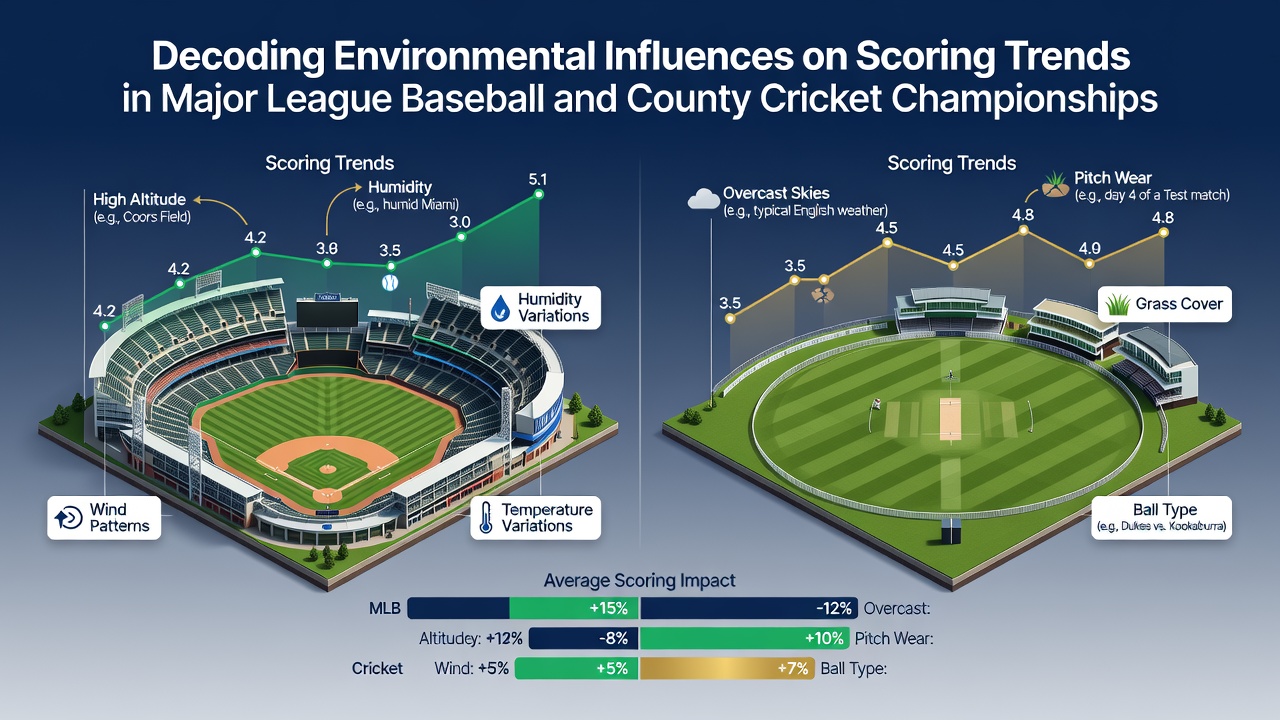
Wind direction and speed further modify outcomes. A consistent breeze blowing out to the outfield or boundary adds distance to fly balls and lofted drives. Outfielders and fielders adjust positioning accordingly, which in turn opens gaps that batters exploit. In August 2026, several MLB stadiums and County grounds will host matches under forecasted wind patterns that meteorologists predict will favor hitters and stroke-makers.
Precipitation and Pitch Condition Interactions
Rain affects both the ball and the playing surface. Light showers can make baseballs heavier and cricket balls less responsive, while heavy rain delays or shortens matches and alters pitch preparation. County Championship regulations allow for covered pitches that retain moisture differently than uncovered surfaces, influencing seam grip and bounce consistency. MLB grounds crews manage similar variables through tarpaulins and drying techniques that restore playability after showers.
Long-term records reveal that matches resumed after rain interruptions often produce different scoring distributions in the remaining overs or innings, as batters and bowlers recalibrate to changed conditions.
Seasonal and Regional Patterns
Scoring trends follow predictable seasonal cycles tied to climate zones. MLB teams in arid southwestern parks post higher offensive numbers during summer, whereas northern and coastal venues show more variability linked to marine layers and temperature swings. In England, southern counties tend to produce flatter pitches and higher totals in dry spells, while northern and midland grounds experience more swing-friendly conditions during cooler, damper periods.
These geographic differences create strategic considerations for team selection and lineup construction. Managers and captains review venue-specific weather forecasts and historical data to anticipate how environmental factors will shift run expectancy on any given day.
Conclusion
Environmental variables produce consistent, quantifiable effects on scoring in Major League Baseball and the County Championship. Altitude reduces drag, temperature modulates ball hardness and air resistance, humidity and wind alter movement, and precipitation changes surface behavior. Ongoing collection of meteorological and performance data enables leagues, teams, and analysts to refine expectations and preparation for matches scheduled through August 2026 and beyond.