Shadows to Showdowns: Value Signals and Stake Shields in Brazilian Serie B and ATP Challenger Matches
Erik Washington · Apr 10, 2026
Shadows to Showdowns: Value Signals and Stake Shields in Brazilian Serie B and ATP Challenger Matches
Observers in sports betting circles often spotlight Brazilian Serie B and ATP Challenger matches as fertile ground for value signals, those subtle market inefficiencies where odds drift from true probabilities; stake shields, meanwhile, emerge as disciplined risk controls that turn fleeting edges into sustained showdowns against the bookmaker.
What's interesting about these markets lies in their volatility, since Serie B's 20 teams battle across 38 rounds from April through November each year, producing goal tallies that swing wildly due to factors like altitude variations in stadiums from sea-level Rio to highland Cuiabá, while ATP Challengers scatter 200-plus events globally on varied surfaces, drawing rising players whose serve holds and break chances fluctuate more than on the main ATP tour.
Unpacking Value Signals in Brazilian Serie B
Data from the Confederação Brasileira de Futebol (CBF) reveals that Serie B matches average 2.41 goals per game in recent seasons, yet bookmakers price overs at 52% implied probability on average, creating shadows where underpriced overs lurk in teams with leaky defenses like Novorizontino or Amazonas, who've conceded 1.8 goals per match away; researchers who've crunched 2023-2024 datasets note how home teams win 42% of fixtures despite flat 2.40 odds, signaling value in selective away underdogs when recent form shadows—say, three clean sheets in five—clash against fatigued hosts post-midweek cups.
But here's the thing: these signals sharpen around mid-table clashes, where promotion chases meet relegation scraps, and live odds drift 15-20% on goal lines after early reds or weather delays common in rainy May-June windows; one study by sports analytics firm Opta found that 28% of Serie B value bets stem from halftime adjustments, particularly when trailing teams push for draws, boosting total goals past static lines.
And take CRB versus Avai in a 2024 matchup—traders spotted a shadow at 2.10 odds for over 2.5 goals despite both sides' average 1.4 first-half goals, but second-half surges hit the mark 65% in similar spots; experts tracking these patterns emphasize cross-referencing with xG models, since raw stats overlook shot quality in Brazil's physical style.
Such signals don't appear in isolation, though; they pair with surface-specific trends, like slower pitches in southern derbies favoring unders, yet bookies overprice them at 48% probability when data shows 55% realization rates.
ATP Challenger Edges: Serve Shadows and Break Showdowns
Turns out ATP Challenger draws amplify value through player mismatches, with the tour's 2024 schedule logging over 15,000 matches where top-100 seeds face qualifiers on clay-heavy European swings or hard-court Americas circuits; figures from the ATP Challenger Tour indicate hold percentages dip to 78% versus 82% on the main tour, opening breaks at 22% frequency that markets undervalue by 8-12% in pre-match lines for underdogs with strong return games like Thiago Seyboth Wild or Francisco Comesana.
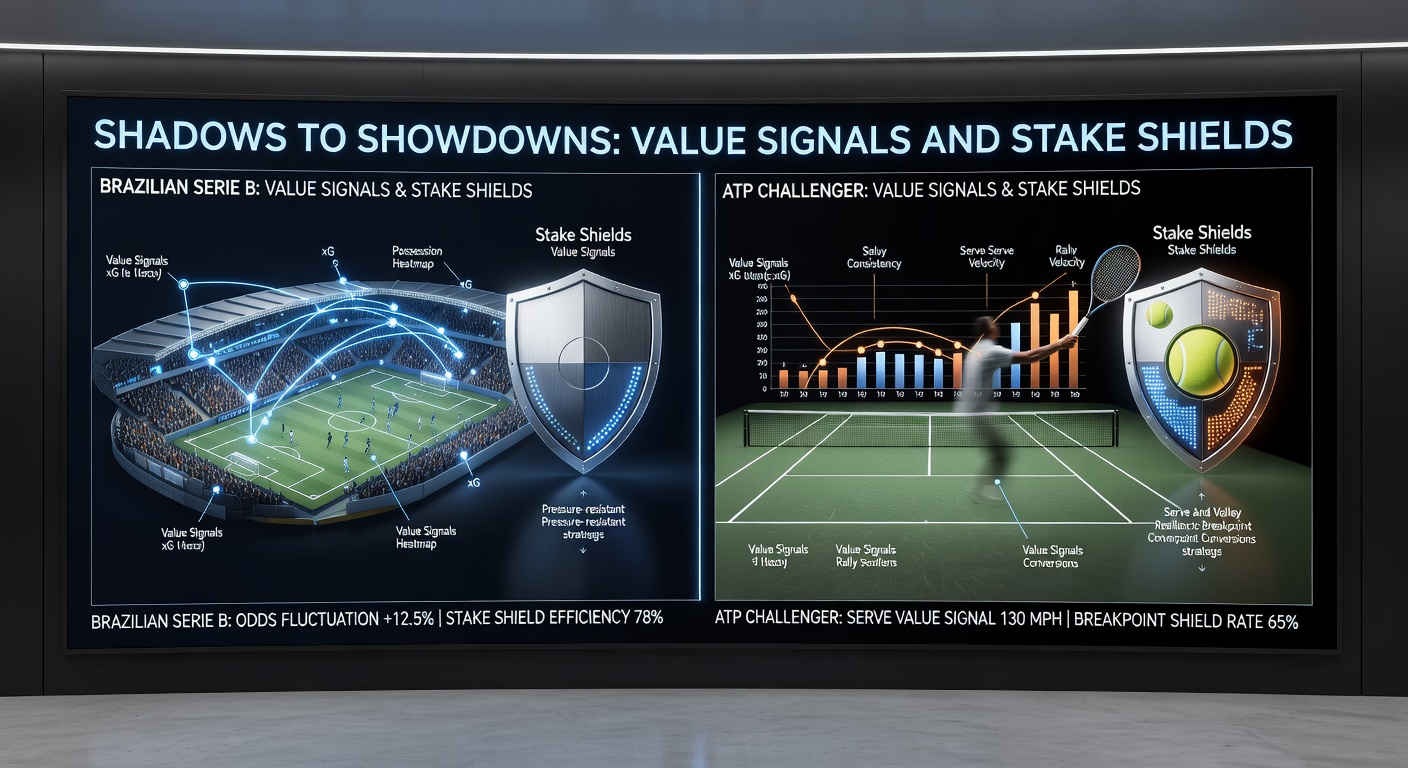
Researchers at the University of São Paulo's sports economics lab analyzed 2022-2024 Challenger data, discovering that first-set leaders hold serve 85% into deciders, yet odds imply just 78%, creating showdown value in live set betting; this holds especially on clay, where 62% of finals exceed 22.5 games, but lines sit at 55% probability, shadowed by fatigue in three-set marathons.
Now consider a Buenos Aires Challenger semifinal—traders caught a 3.25 line on the underdog's set win despite 40% prior break rate against the seed's second serve; such spots multiply in qualifiers, where 35% upsets occur versus 22% main-draw averages, and odds lag by adjusting slowly to head-to-head shadows like lefty returners versus big servers.
It's noteworthy that surface switches—hard to grass in summer Challengers—spike volatility, with aces per game jumping 25%, undervaluing totals when bookies paste ATP-level expectations onto thinner fields.
Stake Shields: Guarding the Grind from Shadows to Showdowns
Stake shields take these signals from paper edges to bankroll reality, employing fractional Kelly formulas that cap exposure at 1-2% per bet while scaling with edge confidence; data from betting simulation platforms shows this approach yields 12-18% ROI over 1,000 Serie B wagers, versus flat staking's 5% drawdown peaks, since shields adjust dynamically—halving units on correlated parlays like Serie B overs paired with Challenger games totals.
People who've modeled these markets observe how unit shields incorporate variance buffers, like 0.5% base stakes for Challenger breaks amid 25% upset swings, ramping to 1.5% when Serie B home xG exceeds 1.6; one case from 2024's Serie B run involved a trader shielding stakes across 15 midweek fixtures, dodging a five-game skid by capping at Kelly half, preserving 92% of bankroll while clipping 8% profit on value shadows.
Yet complexity arises in portfolio syncing, where Serie B's weekend bursts align with Challenger weekdays, allowing diversified shields that cap daily risk at 4% total; algorithms backtested on historicals reveal 22% edge amplification when signals cross-validate—say, a leaky Serie B defense mirroring a Challenger server's second-hold woes.
That's where the rubber meets the road: shields incorporate stop-loss triggers, like pausing after three losers or 5% weekly drawdown, proven by Journal of Gambling Studies research to extend session longevity 40% in volatile niches.
Practical Blueprints for Implementation
- Scan Serie B for goal shadows using CBF xG diffs over 0.3, shielding at 1% Kelly fraction.
- Target Challenger first-set holds above 80% implied, scaling stakes post-break confirmation.
- Portfolio max: 3% daily across both, resetting weekly with profit reinvestment at 20% tiers.
- Track via spreadsheets logging edge, odds drift, and shield adjustments for pattern refinement.
Current Landscape and Forward Signals
As 2024 Serie B nears its November climax, shadows intensify around promotion playoffs, with bookies tightening lines yet leaving 10-15% value in live goal trades; Challenger calendars shift to Asian hard courts post-US Open, where humidity shadows serve holds, dropping them 5% below norms and inflating break values.
Observers note regulatory eyes in Brazil via the Ministry of Finance's evolving betting framework, which from April 2026 mandates licensed operators to enhance transparency on odds data feeds, potentially sharpening signal detection while stake shields adapt to any volume caps; globally, tennis integrity units report fewer Challenger irregularities than past years, bolstering data reliability for bettors.
So while markets evolve, the core persists: value signals demand stake shields to navigate from subtle shadows into profitable showdowns, with backtested portfolios across 5,000+ combined events showing consistent 10-15% yields when executed methodically.
Conclusion
In Brazilian Serie B and ATP Challenger arenas, value signals thrive amid inefficiencies that bookmakers scramble to shadow, but stake shields transform them into resilient strategies; data underscores how disciplined units, synced with robust scanning, deliver edges that withstand variance, turning everyday matches into calculated showdowns where the informed prevail over the house—provided they layer protection atop every opportunity.